Overview
Sound design workflows frequently oscillate between time-consuming library searches and the complexity of procedural synthesis, with practitioners typically relying on disconnected tools to address each challenge separately.
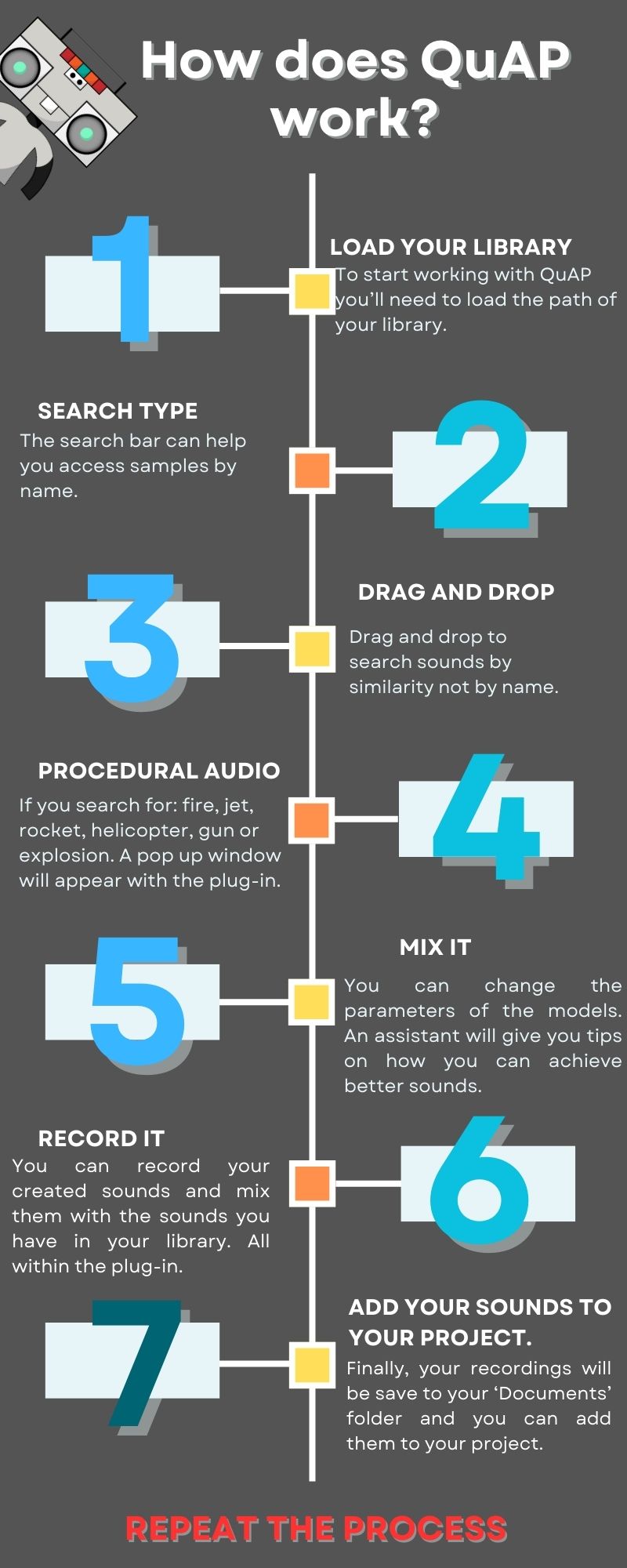
This paper introduces Quality Audio Prototyping (QuAP), a working prototype that unifies content-based audio retrieval and procedural sound generation within a single interface, reducing the procedural distance between a narrative concept and its sonic realisation.
QuAP integrates a similarity-based retrieval engine with real-time procedural audio models, complemented by a rule-based assistant that provides perceptually informed parameter guidance, offering definitions and recommendations derived from empirical optimisation rather than requiring prior synthesis knowledge.
Preliminary evaluation confirms the viability of this approach: subjective assessment demonstrated statistically significant perceptual improvements in five of six embedded synthesis models, and an encoder ablation study established the preferred retrieval architecture on a sound effect dataset.
A user evaluation with 16 practitioners confirmed the tool's workflow utility, with all participants agreeing that the parameter assistant preserved creative agency while lowering the barrier to procedural interaction.
System Architecture
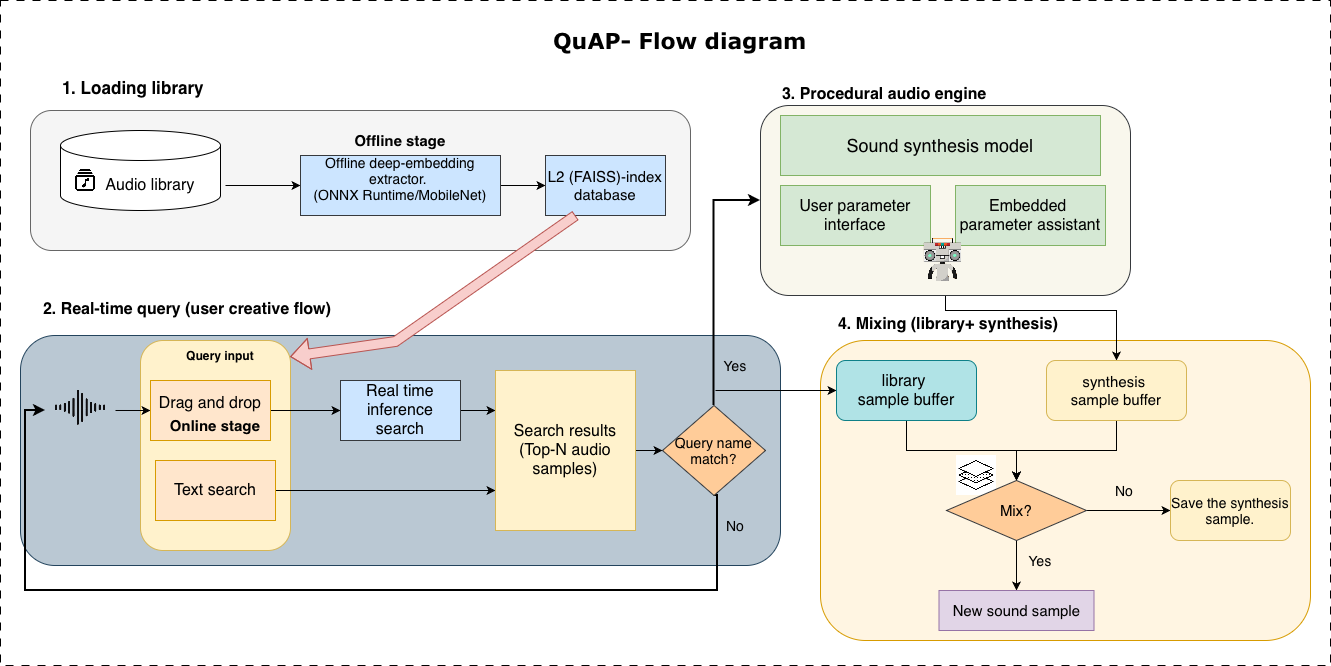
Figure 1: QuAP system architecture.
The loading library stage (top left) processes the user's audio library through an offline deep-embedding extractor and FAISS indexing backend. The real-time query stage
(bottom left) accepts drag-and-drop or text input.
Where procedural models are available, the system routes to the procedural audio engine (top right). The resulting synthesis
output may be layered with retrieved library samples in the mixing stage (bottom right).
Optimisation Details
Full details of the procedural model optimisation process, parameter adjustments, and subjective evaluation
results across all sound categories are available at the companion project website:
saop-project.netlify.app